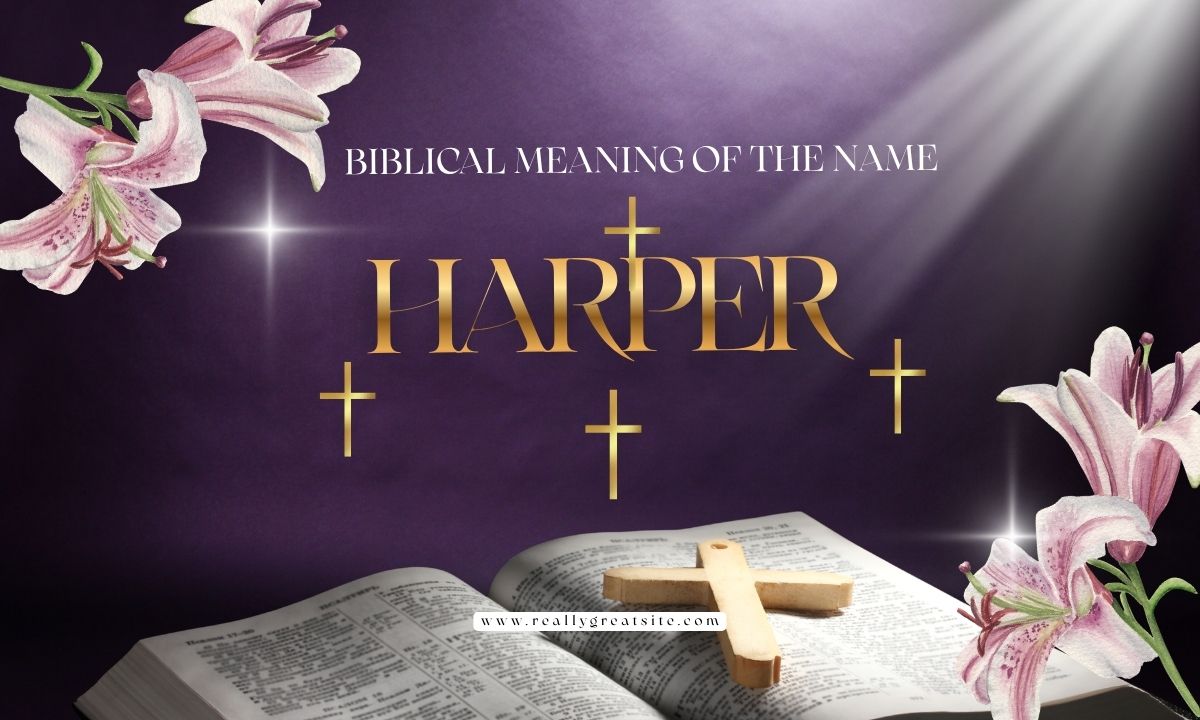
The Special Biblical Meaning of the Name HARPER
Few names carry the kind of quiet artistry that Harper does. It sounds musical before you even know its history, and once you learn the story behind it, that impression only grows stronger. Harper is not a name you find printed in a genealogy list in Scripture, yet its roots reach directly into one of the most powerful symbols of biblical worship: the harp.
For centuries, the harp represented far more than pleasant background sound. It was an instrument of praise, prophecy, comfort, and even spiritual battle. When parents search for the biblical meaning of Harper, they are really asking a deeper question: does this name carry a calling? The answer, drawn from Scripture and centuries of Christian tradition, is a resounding yes.
This article walks through the etymology, biblical background, spiritual symbolism, and character qualities connected to the name Harper. Whether you are naming a child, exploring your own identity, or simply curious about faith-based baby names, you will find a complete and grounded look at what this name has meant across history and what it can mean for the person who carries it today.
Names hold weight far beyond simple identification. Throughout Scripture, names were chosen with intention, often reflecting a hope, a promise, or a calling placed over a person’s life. While modern naming culture leans heavily on sound and popularity, many families still search for that older, deeper layer of meaning. Harper sits comfortably at the intersection of both worlds. It is stylish enough to feel current, yet rooted enough in biblical symbolism to feel purposeful. That balance is a large part of why the name continues to grow in popularity among families who care about faith and heritage as much as they care about how a name sounds on a birth certificate.
The Etymology and Historical Roots of Harper
The name Harper comes from Middle English and Old English roots, tracing back to the word “hearpere,” which simply meant a person who plays the harp. Unlike many modern names invented for sound alone, Harper began as a description of a job. It told you exactly what a person did for a living and, in many communities, what role they held within the household or the church.
Occupational surnames like Harper, Baker, Smith, and Carpenter developed during the medieval period as a practical way to distinguish one family from another in a growing population. A family known as “Harper” was, generations ago, a family of musicians. They played at gatherings, courts, and religious ceremonies, often passing the skill from parent to child.
From Occupation to Identity
Occupational surnames tend to follow a predictable pattern. A skill becomes a label, the label becomes a surname, and eventually the surname becomes detached from the original trade and turns into a standalone identity. This is exactly what happened with Harper.
By the late medieval period, Harper had stopped functioning strictly as a job title and had become a recognized family name across England and Scotland. Families carried it forward even after none of their members still played the harp for a living. The name had absorbed a new meaning: it now represented lineage, reputation, and a connection to craftsmanship and artistry rather than a literal occupation.
This shift matters because it shows how a name tied to skillful, dedicated labor can become a marker of identity and character. The people who first carried the surname Harper were valued for precision, patience, and creative discipline, qualities that outlived the actual instrument.
It is also worth remembering that in medieval society, a harper often held a respected place within a household or court, sometimes even a royal one. Musicians were entrusted with marking important occasions, easing tension, and preserving stories through song long before written record keeping was common. That early reputation for trustworthiness and skill helped shape the name into something associated with reliability as much as artistry.
The Modern Transformation
In the twentieth and twenty-first centuries, Harper made another transformation, this time from a surname into a popular first name, especially for girls, although it is increasingly used for boys as well. Its rise in Western naming trends has been rapid, helped along by its clean sound, easy spelling, and the warmth associated with musical names.
What makes this modern shift interesting is that Harper never lost its original meaning along the way. Even parents who have never picked up a harp are often drawn to the name because it still feels artistic, gentle, and purposeful. The name carries its history quietly, the way a family heirloom carries the memory of the person who first owned it.
The Harp in Biblical Scripture: A Deep Dive
To understand the biblical meaning of Harper, you have to understand the instrument itself. The harp appears throughout the Old and New Testaments, and it is almost never mentioned casually. It shows up at pivotal moments of worship, warfare, prophecy, and heavenly praise.
In ancient Israel, the harp, sometimes translated from the Hebrew word “kinnor,” was one of the primary instruments used in temple worship. It accompanied psalms, processions, victories, and moments of deep spiritual need. Understanding these appearances gives real depth to anyone exploring what Harper might symbolize spiritually.
King David: The Archetypal Harper
No figure in the Bible is more closely tied to the harp than King David. Long before he became king, David was known as a skilled musician. First Samuel 16:23 describes how David would play the harp for King Saul, and the tormenting spirit troubling Saul would lift whenever David played.
This passage is remarkable because it shows music functioning as more than art. David’s harp playing brought relief, calm, and spiritual covering into a dangerous, unstable situation. Scripture also notes that David was a man after God’s own heart, and his musical gift was inseparable from his devotion. He did not simply perform; he ministered through sound.
For anyone named Harper, David’s story offers a powerful reference point. It suggests a life where creative gifts are not separate from faith but are one of the primary ways that faith gets expressed and lived out.
The Psalms: A Harper’s Songbook
The Book of Psalms is essentially a collection of songs, many of them written to be played on stringed instruments including the harp. Several psalms directly reference the instrument. Psalm 33 calls believers to praise God with the harp and to make music skillfully. Psalm 150, the final psalm, lists the harp among the instruments used to praise God with everything that has breath.
These psalms were not written for background ambiance. They were written for worship, lament, celebration, and honest conversation with God. A harper in ancient Israel was, in many ways, a spiritual leader, someone entrusted with guiding a community through every emotional and spiritual season using music.
For the name Harper, this connection to the Psalms suggests a life of range and honesty, one where joy, sorrow, gratitude, and hope can all be expressed authentically, much like the psalmists modeled for centuries of believers who came after them.
Prophetic Power in Music
Scripture also connects music, and harp playing specifically, with prophecy. In 1 Samuel 10, a group of prophets is described as coming down from a high place with a harp, tambourine, flute, and lyre, prophesying as they played. In 2 Kings, the prophet Elisha called for a harpist before he prophesied, and as the musician played, the hand of the Lord came upon him.
This pattern appears repeatedly. Music, especially stringed instruments like the harp, seemed to prepare hearts and minds for spiritual sensitivity. It quieted distraction and opened space for divine communication. This is one reason many modern worship leaders and musicians describe their craft as more than performance. It becomes a form of spiritual attentiveness.
A person named Harper, viewed through this lens, carries symbolic ties to spiritual readiness, someone whose gifts can create space for others to hear from God more clearly.
Heavenly Harps
The harp does not disappear after the Old Testament. It reappears vividly in the Book of Revelation, where heavenly worship is described using harps. Revelation 5 pictures elders holding harps as part of worship before the throne, and Revelation 15 describes those who had triumphed standing beside a sea of glass, holding harps given to them by God.
This is a striking detail. The harp is not just an earthly instrument tied to ancient Israel. In biblical imagery, it is also an instrument of eternal, heavenly praise. That gives the name Harper a symbolic reach that spans from earthly worship all the way to the picture of eternal worship described in Revelation.
Five Biblical Themes Embodied by Harper
Pulling these scriptural threads together, five consistent themes emerge for anyone exploring the biblical meaning of the name Harper. These themes are not claims about destiny, but they do reflect the spiritual associations carried by the harp throughout Scripture.
Worship and Adoration
At its core, the harp was an instrument built for worship. Biblical harpers were not entertainers performing for applause. They stood in service of something greater than themselves, using their skill to direct attention toward God. The name Harper naturally carries this theme of wholehearted adoration and devotion.
Spiritual Warfare Through Praise
David’s harp playing did not just soothe Saul, it pushed back a tormenting spirit. This shows a biblical pattern where worship functions as a form of spiritual warfare. Praise is not passive; it is active resistance against darkness, discouragement, and oppression. The name Harper carries echoes of this same active, protective kind of worship.
Prophetic Sensitivity and Divine Inspiration
As seen with Elisha and the prophets in 1 Samuel, music created an atmosphere where prophetic insight could flow. This theme suggests spiritual sensitivity, the ability to sense God’s presence and communicate it to others. People connected to this theme often notice needs before they are spoken and respond with intuitive compassion.
Ministry of Comfort and Healing
David’s harp brought relief to a tormented king. Music throughout Scripture repeatedly appears as a source of comfort during grief, anxiety, and spiritual distress. The name Harper carries associations with this healing role, a reminder that creative gifts can be used to bring peace to hurting people.
Joyful Celebration and Testimony
Music in the Bible was also simply joyful. After the Israelites crossed the Red Sea, Miriam led the women in celebration with a timbrel, and instruments accompanied victories, weddings, and festivals throughout Scripture. The name Harper reflects this exuberant, celebratory spirit, an inclination toward gratitude expressed out loud rather than kept quiet.
| Biblical Theme | Scriptural Reference | Core Meaning for Harper |
|---|---|---|
| Worship and Adoration | Psalm 33:2-3, Psalm 150:3 | A life oriented toward honoring God |
| Spiritual Warfare Through Praise | 1 Samuel 16:23 | Using creative gifts to push back darkness |
| Prophetic Sensitivity | 1 Samuel 10:5, 2 Kings 3:15 | Spiritual attentiveness and insight |
| Comfort and Healing | 1 Samuel 16:23 | Bringing peace to those who are struggling |
| Joyful Celebration | Exodus 15:20 | Gratitude expressed freely and openly |
The Spiritual Meaning and Biblical Symbolism of the Name Harper
Taken together, the spiritual meaning of Harper centers on a life that harmonizes faith, creativity, and service. Though the name does not appear as a person in Scripture, its connection to the harp places it firmly within one of the Bible’s most consistent symbols of devotion.
Symbolically, Harper represents the idea of being an instrument in someone else’s story. Just as a harp is played by human hands to bring music into a room, a person named Harper is often seen as someone whose gifts are meant to be used in service of something bigger than personal recognition. The symbolism points toward humility paired with skill, and sensitivity paired with courage.
In Christian naming traditions, this combination is highly valued. Names that carry symbolic weight, rather than simply sounding pleasant, are often chosen because parents want their child’s identity to be tied to purpose from the very beginning. Harper fits naturally into that category, alongside other faith-inspired baby names chosen for their spiritual resonance rather than only their popularity.
Character Qualities Reflected in the Name Harper
Names can shape the way people see themselves and the way others perceive them. While no name determines a person’s character, the biblical associations tied to Harper point toward a recognizable set of qualities that often show up in people who carry this name.
Sensitivity to the Holy Spirit
Just as biblical musicians created space for prophetic insight, people connected to the name Harper often display a heightened awareness of spiritual atmosphere. They notice shifts in mood and tone that others might miss, and they tend to respond with care rather than indifference.
Creative Expression
Creativity is at the very center of this name’s meaning. This does not always mean literal musical talent. It can show up as writing, art, problem solving, or simply a distinctive way of communicating ideas. The name carries an expectation that gifts should be developed and shared, not hidden away.
Servant-Hearted Leadership
Biblical harpers served kings, congregations, and communities through their gift. This theme translates into a leadership style built on service rather than dominance. People associated with this name often lead by lifting others up rather than by asserting authority.
Courage in Calling
Standing before a troubled king and playing music that could either calm or provoke him required real courage. The name Harper carries this same undertone, a willingness to step into difficult situations using one’s gifts, even when the outcome is uncertain.
Bridge-Builder
Music has always had the ability to connect people across differences in language, culture, and circumstance. The symbolism of Harper includes this bridge-building quality, an ability to bring people together and create shared moments of connection and understanding.
Emotional Intelligence
The Psalms cover nearly every human emotion, from grief to celebration. A name so closely tied to this songbook naturally carries associations with emotional intelligence, the capacity to recognize, process, and respond to feelings in a healthy and constructive way.
The Role of Music in Biblical Worship and Spiritual Life
Music in the Bible was never treated as an afterthought. It played a structural role in temple worship, with entire groups of Levites assigned specifically to musical service. First Chronicles 15 and 16 describe David appointing musicians to play harps, lyres, and cymbals as part of organized worship before the ark of the covenant.
Beyond formal worship, music also appeared in personal and communal moments throughout Scripture. It marked victories, as with Miriam’s song after the Red Sea crossing. It expressed grief, as in many of the lament psalms. It accompanied prophetic ministry, as seen with Elisha. It even appears in descriptions of heaven itself, where harps are part of eternal worship in Revelation.
This consistent presence tells us something important. Biblical writers did not separate music from spirituality; they treated the two as deeply connected. Sound, rhythm, and melody were understood as legitimate pathways to encountering God, alongside prayer, fasting, and Scripture reading. For a name rooted in music, this history adds real theological weight rather than simply aesthetic appeal.
It is also worth noting that biblical musicians trained for years before serving in temple worship. First Chronicles 25 describes musicians who were skilled and trained in singing to the Lord, organized into groups under the direction of their families. This detail matters because it shows that biblical music ministry was never treated casually. It required discipline, mentorship, and years of practice, much like any serious craft. The name Harper, tied to this tradition, carries an implied respect for mastery and patience rather than instant or shallow expression.
This same principle shows up in how Scripture describes worship as a lifestyle rather than a single event. Passages like Colossians 3:16 encourage believers to teach and admonish one another with psalms, hymns, and spiritual songs, singing with gratitude in their hearts. Worship, in this sense, was never confined to a temple or a specific ceremony. It was woven into daily life, conversation, and community. A name connected to this broader vision of music carries with it a reminder that creative gifts are meant to be lived out consistently, not reserved only for special occasions.
Harper in Christian Culture and Modern Application
The themes connected to the name Harper are not just historical curiosities. They show up clearly in modern Christian culture, particularly within worship communities and creative ministries that have grown significantly over the past few decades.
The Worship Movement
Contemporary Christian worship has placed renewed emphasis on the connection between music and spiritual encounter. Worship leaders today are often described in language very similar to how Scripture describes David: skilled musicians whose playing helps usher a congregation into God’s presence. The name Harper fits naturally within this modern movement, echoing its biblical foundation.
Creative Arts Ministries
Many churches now operate dedicated arts ministries covering music, visual art, dance, and drama. These ministries reflect the same principle found throughout Scripture, that creative gifts can be dedicated to worship and service rather than treated as separate from faith. The name Harper aligns closely with this growing recognition of creativity as a spiritual calling.
Intentional Naming
More Christian parents today are choosing names based on meaning rather than trend alone. Harper appeals to this desire because it offers both a contemporary sound and a substantive biblical connection. It allows parents to give their child a name that feels current while still carrying a story rooted in centuries of worship tradition.
Living the Harper Calling
For someone already carrying this name, living out its meaning does not require musical talent. It can be as simple as using whatever gifts one has, whether that is teaching, listening, organizing, or comforting others, in a spirit of service and worship. The calling behind the name is less about the specific skill and more about the posture behind it.
Biblical Names with Similar Spiritual Significance
Harper is not alone in carrying this kind of layered, symbolic meaning. Several other names share similar connections to worship, creativity, or spiritual calling, making them useful points of comparison for parents exploring faith-based options.
| Name | Meaning | Biblical or Spiritual Connection |
|---|---|---|
| Harper | Harp player | Worship, prophecy, and comfort through music |
| Asa | Healer | A king known for seeking God wholeheartedly |
| Asaph | Collector or gatherer | A Levite musician who wrote several psalms |
| Miriam | Beloved, bitter, or rebellion | Led worship with a timbrel after the Red Sea |
| Zion | Highest point, fortress | Symbol of God’s dwelling and worship |
| Selah | Pause, reflect | A musical term found throughout the Psalms |
Names like Asaph and Miriam are particularly close companions to Harper, since both are tied directly to biblical figures who used music as an expression of faith. Together, these names form a small but meaningful family of options for parents drawn to the connection between creativity and worship.
Powerful Scripture Verses for Those Named Harper
Several verses stand out as especially meaningful for anyone connected to the name Harper, whether through personal reflection, prayer, or simply a deeper appreciation of the name’s roots.
- Psalm 33:2-3, which calls believers to praise God skillfully with the harp and to sing a new song.
- Psalm 150:3-4, which lists the harp among instruments used to praise God with everything that has breath.
- 1 Samuel 16:23, which describes how David’s harp playing brought relief and peace to a troubled king.
- 1 Chronicles 15:16, which describes musicians appointed to play harps and lyres with joy before the ark of the covenant.
- Revelation 5:8, which pictures harps as part of worship before God’s throne in heaven.
These passages together paint a full picture, moving from earthly worship and personal comfort all the way to eternal praise, showing just how far the symbolism connected to this name actually reaches.
1 Samuel 16:23: The Harper’s Defining Verse
If one verse defines the biblical meaning of Harper more than any other, it is 1 Samuel 16:23. The passage describes how whenever a tormenting spirit troubled King Saul, David would take up his harp and play, and Saul would find relief, the spirit would depart, and he would feel better.
This verse captures the essence of what a biblical harper represented. It was not entertainment for entertainment’s sake. It was skilled, faithful use of a gift to bring real, tangible relief into someone else’s suffering. David did not play to be noticed. He played because his gift could serve a genuine need.
For anyone carrying the name Harper, this verse offers a kind of quiet mission statement. It suggests that whatever gifts a person holds, whether musical or otherwise, can be offered in service of someone else’s peace and wellbeing. That is a powerful legacy to carry inside a single name.
Praying Over a Child Named Harper
Parents who choose meaningful names often want to pray intentionally over the identity that name represents. A prayer for a child named Harper might ask that their life be marked by the same qualities found throughout Scripture’s harpers: sensitivity to God’s presence, courage to use their gifts even in difficult seasons, and a heart inclined toward bringing comfort and joy to others.
Such a prayer might ask that their creativity always remain connected to purpose rather than pride, that their sensitivity to others’ pain becomes a source of healing rather than a burden, and that their life, like the psalms themselves, reflects honesty in every season, whether joyful or difficult. It is a prayer for both giftedness and humility, growing together throughout their life.
You can also checkout this article as well Biblically Accurate Lucifer: Unveiling the Truth Behind His Story and Misconceptions
Conclusion
The name Harper carries a rare kind of depth, tracing its roots from a medieval occupation all the way to some of the most meaningful moments in biblical history. Though never a named figure in Scripture, its ties to worship, prophecy, comfort, and heavenly praise give it lasting spiritual weight.
For anyone bearing this name, or considering it for a child, Harper offers more than pleasant sound. It offers a quiet invitation to live a life of skillful devotion, using whatever gifts one holds in service of God and others, much like the harpers of Scripture did centuries ago.

Hey, I am John Gabriel, and I am passionate about exploring Bible meanings, biblical names, scriptures, symbols, and spiritual insights. I create well-researched, easy-to-understand content that helps readers discover the deeper messages of God’s Word with clarity, faith, and biblical understanding.